Aferiy P280: Should You Trust an Unfamiliar Brand With Your Backup Power?
 Steven
Aferiy P280: Should You Trust an Unfamiliar Brand With Your Backup Power?
A practical look at a 2 kWh power station for preppers, RV owners, and anyone nervous about buying from a name they don’t recognize.
If you’ve shopped for a portable power station lately, you know the big names: Bluetti, EcoFlow, Anker, Jackery. Then there’s Aferiy, a brand most people haven’t heard of, selling a 2,048 Wh unit with more output than several of the household names, often at a lower price. That combination makes a careful buyer ask the obvious question: what’s the catch?
What the P280 is
The P280 is a 2,048 Wh power station built on LiFePO4 (lithium iron phosphate) cells, rated by the manufacturer for more than 4,000 charge cycles. Key specs:
• Output: 2,800 W continuous pure sine wave (5,600 W peak)
• Charging: up to 1,800 W from the wall, up to 1,200 W from solar
• UPS mode: switches to battery in under 10 ms during an outage
• Ports: 13 outputs, including three AC outlets
• Expansion: up to 10,240 Wh using add-on P280-B batteries, which can’t be used on their own
• Size and weight: 398 × 280 × 315 mm, 21.6 kg (about 48 lb)
It’s a stay-at-home or stay-in-the-camper unit. Reviewers describe it as closer to a compact home backup system than a grab-and-go travel companion.
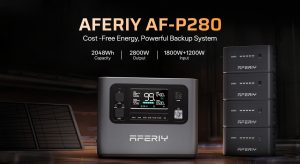
Growing the system with P280-B battery packs
The P280 can grow from 2,048 Wh to 10,240 Wh, in 2 kWh steps, by adding P280-B expansion batteries. Notebookcheck describes it as a fivefold increase: the base unit plus four packs. The packs stack on top of the base unit and link to it with cables, so there is no rewiring.
A few things to know before you plan around it:
• Packs can’t work alone. A P280-B must be connected to a P280 base unit, per a retailer FAQ.
• You add runtime, not extra watts. Because the packs depend on the base unit, plan your loads around its 2,800 W rating. Fully expanded, 10,240 Wh would run a 500 W load for about 20 hours on paper, less after conversion losses.
• Packs aren’t free. One European retailer lists the P280-B at around €649, reduced from €899. That is close to what a discounted complete P280 costs, so weigh a second full unit, which gives you redundancy, against a pack, which gives you one bigger system.
• Mobility drops. Every pack adds its own weight and bulk. Notebookcheck notes that mobility naturally suffers, which makes this a build-it-once, leave-it-in-place upgrade.
This is the P280’s strongest selling point for preppers. You can start with one unit now and add capacity as budget allows, without replacing anything.
The fixed-capacity sibling: Aferiy P210
A French retailer comparison says the two share the same 2,048 Wh LiFePO4 battery and differ mainly in output, recharge speed and expandability. The P210 is the older design, listed in a catalog as added in July 2024, against November 2025 for the P280.
| Feature | Aferiy P210 | Aferiy P280 |
|---|---|---|
| Capacity | 2048 WHr | 2048 WHr |
| Continuous AC load | 2400 watts | 2800 watts |
| AC Charging | 1100 watts | 1800 watts |
| Max Solar Input | 500 watts | 1200 watts |
| Expandable | No | Yes - to 10,240 watts |
| Weight | 22 kg | 21.6 kg |
| Warrenty | 7 years | 7 years |
| UK promo price | £619 | £739 |
P210 figures come from a retailer listing and a BushcraftUK review. P280 figures come from Notebookcheck and TechRadar. The UK prices are promo-code prices, so check what’s current. The 7-year warranty is the brand’s claim, and one German review says it applies after registration.
Choose the P210 if 2,400 W covers your loads, 2 kWh is all you’ll ever need, and you want to save roughly £120 at those promo prices.
Choose the P280 if you want the option to add battery packs later, need the extra 400 W of output, or want much faster recharging from the wall or the sun. For preppers and RV owners building up over time, that flexibility is usually worth the extra money.
Why it’s attractive
Raw power. At 2,800 W continuous, the P280 can handle loads that choke many 2 kWh competitors: a space heater, a microwave, power tools, or a well pump with a hefty startup surge. For comparison, the Jackery Explorer 2000 v2 is rated at 2,200 W and the Bluetti Elite 200 V2 at 2,600 W.
Price. Reviewers have seen it on sale between roughly $689 and $800, against a list price around $1,099. The Bluetti Elite 200 V2 and Anker Solix C2000 Gen 2 both sit around $849 at street prices, and the Jackery 2000 v2 lists near $1,499. Prices for all of these swing widely with sales, so check before you buy.
Safe, long-lasting chemistry. LiFePO4 is more thermally stable than the older lithium-ion cells used in many cheaper units, and it lasts far longer. That matters if the unit will sit in your home or camper for years.
Fast recharging and UPS. For preppers, the sub-10 ms switchover means a desktop PC, router, or CPAP machine rides through a blackout without a hiccup. The high AC and solar input limits mean you can refill it quickly when the grid or the sun cooperates.
Room to grow. Stacking batteries up to 10 kWh lets you start modestly and build toward whole-home essentials later.
Where it falls short
Honest reviews found real flaws, and they’re worth knowing before you spend the money.
• The app can be flaky. Notebookcheck reported that remote control through the Aferiy iOS app simply didn’t work in their testing, something they hadn’t run into with major brands. The power station works fine without it, and the on-unit controls are straightforward, but it’s a sign of less polished software.
• It’s loud under load. At full output, fan noise is clearly audible. That matters in a quiet camper at night.
• It’s heavy. 21.6 kg is manageable for moving it between rooms, but tiring if you carry it a few hundred meters regularly. The Aferiy website does offer a custom trolley - but so will your local D.I.Y. store.
• Some details feel budget. TechRadar found the power button cheaper-feeling than the more rugged buttons on some Bluetti models, and another reviewer said the surface finish could look more premium.
• USB-C is modest. The USB-C ports are only 20 W, so a power-hungry laptop will want the AC outlet.
• Car charging is impractical. Via a 12 V socket it takes around 17 to 18 hours, so treat that as a top-up, not a plan, unless you plan on investing in Aferiy's own 680 watt b2b charger. Just ensure your vehicle alternator is up to an extra 60 amps load.
The brand question: should an unfamiliar name worry you?
A lesser-known brand isn’t automatically a red flag, but it does change what you should check before buying. The established brands give you a track record: years of units in the field, mature apps, proven warranty service. With Aferiy, more of that is unproven, and reviewers note that short-term tests can’t verify claims like the 4,000-cycle rating.
Here is what to do about that.
1. Buy from a retailer with a real return policy. Amazon or a reputable electronics seller gives you recourse that a random web store doesn’t. Test the unit hard in the first weeks: run it near its rated load, try the UPS function, and charge it from solar.
2. Read the warranty before you buy. Look at its length, who services it in your country, and whether it’s a ship-it-back process. This is where unknown brands often differ most from the big names.
3. Check the safety certifications for your market. Look for markings such as UL, ETL, or CE, and confirm they apply to the specific model you’re buying, not just the brand.
4. Don’t rely on the app. If you need remote monitoring, test it right away. If you only need the unit to power things, the app matters less.
5. Match the risk to the job. If this is the only thing standing between your family and a freezing house or a medical device without power, buy the proven brand or keep a second backup. If it’s a camper unit or a secondary system, the savings are easier to justify.
| Model | Capacity | AC output | Price (late 2026) |
|---|---|---|---|
| Aferiy P280 | 2048 WHr | 2800 watts | £690 (sale) |
| Bluetti Elite 200 v2 | 2073 WHr | 2600 watts | £850 |
| Anker Solix C2000 Gen 2 | 2048 WHr | 2400 watts | £850 |
| EcoFlow Delta 2 Max 2 | 2048 WHr | 2400 watts | £950 |
| Jackery Explorer 2000 v2 | 2042 WHr | 2200 watts | £1500 |
The Bluetti is rated for 6,000 cycles and comes with a five-year warranty, and the Jackery is the lightest of the group. Neither beats the Aferiy on output per dollar.
Who should buy the P280
Good fit:
• RV and camper owners who want a stationary battery with plenty of output for an air fryer, induction cooktop, or small air conditioner
• Preppers building a modular system who value watts per dollar and plan to expand
• Home-backup buyers covering essentials like a fridge, router, and lights, with the unit sitting ready
Think twice:
• Anyone who needs it to be portable or quiet
• Anyone who depends on a polished app
• Buyers who want the reassurance of a long-established support network
The bottom line
The P280 delivers a lot of power and safe battery chemistry for the money, and reviewers generally found it capable. Its weaknesses are mostly about polish and maturity: the app, the noise, the weight, and a brand without a long track record. If you buy it on sale from a seller with good returns, test it early, and keep the expectations of a value product, it’s a reasonable gamble. If the stakes are high and you’d rather pay about $150 more for a proven name, the Bluetti Elite 200 V2 and Anker Solix C2000 Gen 2 are the safer choices.
Prices and specifications reflect reviews and retailer listings available in late 2026 and change frequently.
Verify current pricing, warranty terms, and certifications before you buy.